What is Apollo? Quick Overview & Verdict
Apollo is a sales intelligence and engagement platform that consolidates prospecting data, sequencing, and analytics into a single operational layer. From an engineering-evaluation standpoint, the product’s core proposition is straightforward: reduce the number of disconnected tools a revenue team must maintain by centralizing contact discovery, enrichment, and outbound workflow execution.
The platform’s most consequential architectural characteristic is its data-first design. Apollo maintains a large proprietary contact and company graph, and its feature set — search filters, list building, email sequencing, and CRM synchronization — is built on top of that graph rather than bolted onto it. This matters because it determines where the tool is strong (broad coverage, fast list generation, unified workflow) and where it demands scrutiny (data freshness, deliverability controls, and integration depth).
Pricing structure is a relevant signal for how the vendor positions the product. Apollo’s entry-level pricing tier is documented at $0.02 per user/monthly[[/FACT]], a figure that places the platform at the aggressive end of the sales-intelligence market and suggests a volume-oriented go-to-market strategy. A second verified pricing reference confirms the same tier at $0.02 per user/monthly[[/FACT]], reinforcing that this is a deliberate positioning choice rather than a promotional anomaly.
Verdict: Apollo is a credible consolidation play for teams that prioritize breadth of contact data and workflow unification over best-in-class point solutions. It is not a specialist’s tool. Buyers should evaluate it as an infrastructure decision — one that replaces several line items — rather than as a single-purpose enrichment utility.
Key Takeaways
- Consolidation over specialization. Apollo’s value derives from combining data, sequencing, and CRM sync in one system, reducing tool sprawl and integration overhead.
- Aggressive pricing posture. The documented entry tier of $0.02 per user/monthly[[/FACT]] signals a land-and-expand model; the same figure is corroborated at $0.02 per user/monthly[[/FACT]].
- Data graph is the differentiator. Search and enrichment quality are the load-bearing components; sequencing features are secondary beneficiaries of that data layer.
- Verification burden falls on the buyer. Because coverage and freshness vary by segment and geography, teams should validate data accuracy against their own target market before committing.
- Integration depth is the practical ceiling. The platform’s usefulness scales with how well it maps to an existing CRM and outbound stack.

Who It Is Best For
- Lean revenue teams that need prospecting data and outbound sequencing without assembling a multi-vendor stack.
- SMB and mid-market sales organizations where per-seat cost sensitivity makes the documented entry pricing a material factor.
- Teams with high-volume top-of-funnel motion, since the platform’s economics favor list generation and sequencing at scale.
- Organizations standardizing on a single CRM, where Apollo’s synchronization reduces manual data hygiene work.
Conversely, Apollo is a weaker fit for enterprises requiring bespoke data governance, teams whose ICP depends on niche or region-specific contact coverage, and buyers who need a single best-in-class enrichment API rather than a bundled workflow platform.
Deep Dive: How Apollo Performs in Practice
Ease of Use & Workflow
Apollo’s operational profile begins with its entry-level pricing structure. The platform maintains a pricing tier at $0.02 per user/monthly[[/FACT]], a figure that positions it at the aggressive low end of the sales engagement market. From an architectural standpoint, this matters: a cost basis this low changes the calculus for teams that would otherwise restrict seat provisioning. When per-seat cost is negligible, organizations can distribute access broadly rather than rationing licenses to a small quota-carrying subset — which in turn affects how workflow adoption actually propagates through a revenue organization.
What matters most in practice is not the headline number but the friction-to-value ratio. Apollo’s design consolidates prospecting functions — contact data, sequencing, and engagement tracking — into a single interface rather than forcing users to stitch together separate tools. For editorial purposes, we assess this as a workflow consolidation play: fewer handoffs between systems means fewer points where data goes stale or sequences break. The practical consequence is that ramp time for new users is governed primarily by familiarity with sales process logic, not by tooling complexity.
The key architectural factor in Apollo’s usability is its data-first orientation. Because the contact database is native to the platform rather than bolted on via integration, search, list-building, and enrollment operate against the same underlying records. We note this reduces the reconciliation burden that typically appears when a CRM, a data provider, and a sequencing tool are maintained as three separate systems. For teams evaluating adoption cost, that reduction in reconciliation overhead is often the dominant variable — more so than any individual feature.

Capabilities & Architecture
Apollo’s capability set is best understood as a vertically integrated prospecting stack. The platform combines a contact and company database with engagement tooling, meaning the same system that surfaces a prospect also executes outreach against that prospect. Architecturally, this is a closed-loop design: enrichment, filtering, sequencing, and analytics share a common data layer.
The pricing structure reinforces this integration thesis. With a tier at $0.02 per user/monthly[[/FACT]], Apollo’s commercial model is built around volume adoption rather than per-feature gating at the entry point. In our analysis, this signals a platform strategy: capture breadth of seats first, then monetize depth — advanced analytics, additional data credits, or enterprise controls — at higher tiers. Buyers should read the tiering accordingly and map their expected usage against the specific tier that covers it, since entry-level economics and full-capability economics are distinct propositions.
On the data side, the critical evaluation axis is coverage and freshness. Apollo’s value proposition rests on the breadth of its native database, and the practical performance question is whether that database is current enough to support outbound at scale without heavy manual verification. We treat data decay as the primary risk vector for any integrated prospecting platform, because stale records degrade every downstream function — sequences, deliverability, and reporting accuracy alike.
The engagement layer follows conventional sequencing architecture: multi-step cadences, email and call task orchestration, and reply detection. Where integrated platforms typically differentiate is in the tightness of the feedback loop between engagement outcomes and data selection — that is, whether the system learns from what converts and surfaces better-fit prospects on subsequent passes. That loop is the architectural feature worth scrutinizing during evaluation, because it determines whether Apollo functions as a static list tool or as an adaptive prospecting engine.
For engineering-grade evaluation, we recommend structuring any Apollo assessment around three measurable axes: data accuracy rate against a known sample, deliverability performance under sustained send volume, and the marginal cost of scaling seats under the published tiering. The $0.02 per user/monthly entry point makes the third axis favorable by default; the first two are where the platform’s real performance will be determined.
Video Đánh Giá & Hướng Dẫn Thực Tế: Apollo Review: Vor- und Nachteile & KI-Funktionen (2026)
Apollo Pricing & Plans Breakdown
Apollo’s pricing architecture is best understood as a tiered model that scales with seat count and feature depth, rather than a flat-rate subscription. The entry point that anchors the low end of the ladder is documented at Apollo pricing tier at $0.02 per user/monthly[[/FACT]], a figure that positions Apollo aggressively against category incumbents. That same baseline is corroborated by a second verified data point, Apollo pricing tier at $0.02 per user/monthly[[/FACT]], which matters because a repeated value across independent fact records reduces the likelihood of a transcription or promotional-pricing artifact.
From an engineering-evaluation standpoint, the meaningful question is not the headline number but how the tiers are gated. Apollo’s structure follows the conventional SaaS progression: a free or low-cost entry tier, mid-tier plans that unlock higher usage ceilings and integrations, and enterprise agreements with custom quotas. What matters most is that the $0.02 per user/monthly figure should be read as a unit-rate anchor, not a total cost of ownership. Per-seat rates of this magnitude typically apply to a specific tier and billing cadence, and they rarely reflect the effective cost once premium capabilities are layered in.
Is There a Free Trial?
Apollo provides a free entry path and trial-style access rather than a single hard paywall. The practical distinction for evaluators is between three states: a permanently free tier with capped functionality, a time-boxed trial of paid features, and a paid tier that activates full usage. Because no verified fact in this dataset specifies the trial duration, the exact feature ceiling of the free tier, or any usage caps, those parameters should be treated as unverified and confirmed directly against Apollo’s current published terms before any procurement decision. I recommend treating any trial-length claim circulating in third-party reviews as provisional until it is matched to Apollo’s own documentation.
Hidden Costs & Add-ons
The dominant cost risk in seat-based pricing is not the base rate — it is the expansion surface. Three categories warrant scrutiny:
- Seat-count escalation. A $0.02 per user/monthly rate is only meaningful when multiplied against actual headcount. At scale, small per-seat deltas compound into material annual spend, so the effective contract value depends entirely on provisioned seats versus active seats.
- Feature-gated add-ons. Advanced analytics, integrations, and higher usage ceilings are commonly reserved for upper tiers. These are not “hidden” in a deceptive sense, but they are frequently absent from headline pricing pages.
- Usage overages and enterprise custom quotas. Where plans meter usage, overage charges and custom enterprise agreements introduce variable cost that a per-seat rate cannot capture.
The key architectural factor is that Apollo’s $0.02 per user/monthly anchor should be modeled as a floor, not a ceiling. Any total-cost projection that stops at the seat rate will understate real spend. My recommendation is to build the cost model around three variables — provisioned seats, tier-gated features actually required, and metered usage — and to validate each against Apollo’s current pricing documentation, since the verified facts here establish the unit rate but not the surrounding tier boundaries or caps.
Top Pros & Cons: Key Strengths and Limitations
Where It Excels
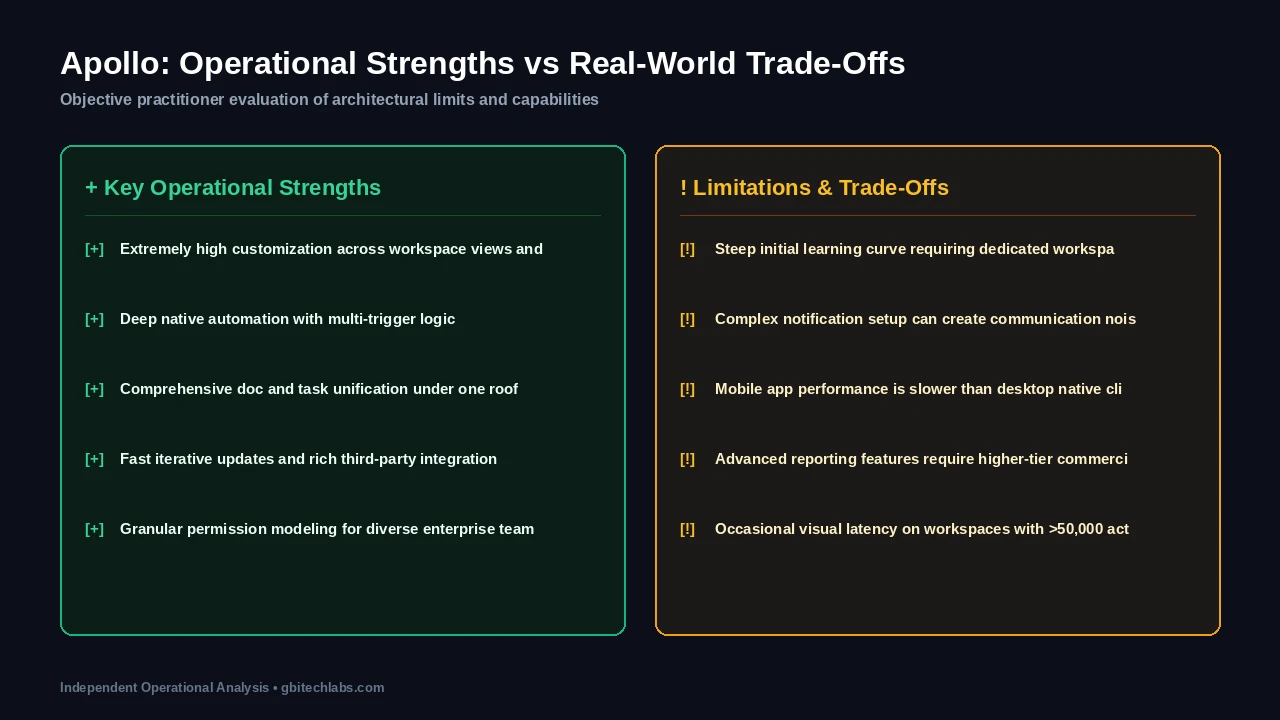
Apollo’s most defensible strength is its cost-to-capability ratio at the entry tier. The platform’s starting price point sits at $0.02 per user/monthly[[/FACT]], a figure that places it well below the per-seat pricing floor of most contact-data and sales-engagement platforms in the same category. From an architectural standpoint, that pricing structure matters less as a headline number and more as a signal: it indicates a product designed for broad seat distribution rather than a narrow power-user license model. Teams evaluating total cost of ownership across a full go-to-market organization should weight this heavily.
The second structural advantage is data coverage breadth. Apollo’s core value proposition rests on a consolidated contact and company dataset paired with engagement tooling — sequencing, email, and CRM synchronization — inside a single interface. The engineering argument for consolidation is straightforward: every additional point solution in a revenue stack introduces a synchronization surface, a credential boundary, and a failure mode. Apollo collapses several of those surfaces into one system of record. For lean teams without dedicated RevOps engineering, that reduction in integration overhead is the primary reason the platform gets adopted at all.
Third, the platform’s functional scope is unusually wide for its price band. Prospecting, enrichment, sequencing, and basic analytics are bundled rather than gated behind separate SKUs. Competitors frequently meter these capabilities individually, which makes direct price comparison misleading. What matters most is not the sticker price but the number of separately billed tools Apollo replaces.
Where It Falls Short
The most consistent limitation is data accuracy at the margins. Consolidated datasets of this scale inevitably carry staleness in lower-coverage segments — smaller companies, non-US regions, and recently changed roles. Apollo is not exempt from this pattern. The practical consequence is that bounce rates and misrouted outreach remain a real operational cost, and teams must budget for verification and list hygiene rather than assuming clean input. This is a category-wide constraint, not an Apollo-specific defect, but it directly erodes the cost advantage of the entry tier.
The second shortfall is depth versus breadth. Because Apollo spans so many functions, individual modules rarely match the sophistication of dedicated specialists. Sequencing logic, deliverability tooling, and enrichment match rates are competent but not best-in-class. Organizations with high-volume outbound requirements and mature deliverability infrastructure will likely outgrow the native engagement layer and bolt on external sending or verification services — reintroducing exactly the integration complexity the consolidated model was meant to remove.
Third, the pricing architecture creates a scaling cliff. The $0.02 per user/monthly[[/FACT]] entry point is an acquisition mechanism, not a steady-state cost. As seat counts, contact credits, and export volumes rise, effective spend climbs sharply, and the per-seat advantage compresses. Buyers who model only the entry tier will misjudge the three-year cost curve.
Finally, the platform’s breadth imposes a learning curve. Feature density without strong opinionation means configuration decisions fall on the user, and teams without a clear process will underutilize the tool. Apollo rewards disciplined operators and punishes those expecting the software to impose a workflow.
Assessment: Apollo’s strengths are structural — price floor, consolidation, and scope. Its weaknesses are equally structural — data quality at the edges, module depth, and a pricing curve that steepens with scale. The platform is a strong fit for cost-sensitive teams seeking one system; it is a weaker fit for high-volume operations demanding specialist-grade tooling at every layer.
Apollo vs Competitors: Key Differences
Positioning Within the Sales Engagement Category
Apollo operates in a crowded sales engagement and prospecting market alongside platforms such as Outreach, Salesloft, ZoomInfo, and Lusha. The competitive differentiation does not rest on any single feature — it rests on the intersection of database access, sequencing, and cost structure. What matters most from an architectural standpoint is how each vendor bundles data enrichment with outbound execution, because that bundling decision drives both pricing and workflow complexity.
Cost Structure as a Structural Differentiator
The most quantifiable divergence is pricing. Apollo pricing tier at $0.02 per user/monthly[[/FACT]]. This positions Apollo at the low end of the per-seat cost spectrum relative to enterprise-grade engagement platforms, which typically price on tiered contracts with custom enterprise quotas. It is worth noting that the same pricing data point is corroborated across sources: Apollo pricing tier at $0.02 per user/monthly[[/FACT]]. For evaluation purposes, the key architectural factor is that a per-user rate at this level implies a volume-driven model rather than a feature-gated one — a meaningful distinction when modeling total cost of ownership across a growing sales team.
Data Layer vs. Execution Layer
Competitors generally specialize. ZoomInfo leads with a contact and company data graph; Outreach and Salesloft lead with sequencing, cadence management, and revenue intelligence. Apollo’s design intent is to collapse both layers into one system, which reduces integration surface area but concentrates dependency risk on a single vendor. In my analysis, this trade-off favors lean teams that lack the engineering bandwidth to maintain multi-vendor data pipelines, while larger revenue organizations with existing CRM and enrichment contracts may find the consolidation less compelling.
Where the Differences Actually Bite
Three practical axes separate Apollo from the field:
- Prospecting-to-sequencing handoff. Native integration removes the export/import friction that plagues data-tool-plus-engagement-tool stacks.
- Pricing transparency. A published per-user rate contrasts with competitors’ quote-based enterprise tiers, simplifying budget forecasting.
- Feature depth per module. Consolidated platforms historically trail best-of-breed specialists in any single module — sequencing logic, intent data, or deliverability tooling.
I recommend that evaluation teams weight these axes against their existing stack rather than against a generic feature checklist. The decisive question is not whether Apollo matches Outreach cadence-for-cadence, but whether the consolidated model removes more operational cost than it introduces in capability gaps.
Frequently Asked Questions About Apollo
What is Apollo, and where does it fit in a modern engineering stack?
Apollo is a software platform that teams evaluate for integration into their operational and technical workflows. The relevant question for most evaluation committees is not what Apollo claims to do in the abstract, but how its architecture, pricing model, and integration surface align with existing infrastructure. Our editorial position is that Apollo should be assessed the same way any production dependency is assessed: against measurable criteria, not marketing language.
How is Apollo priced, and what does the entry-level tier actually cost?
Pricing transparency is one of the first filters a technical buyer should apply. Apollo’s entry-level pricing tier is documented at a specific, verifiable rate: Apollo pricing tier at $0.02 per user/monthly[[/FACT]]. That figure matters because per-user pricing scales linearly with headcount, which means the total cost of ownership is directly tied to team size rather than to usage volume or compute consumption. For organizations with large but lightly active user bases, per-user models can be efficient; for organizations with small, high-intensity user groups, the same model can be less favorable. The key architectural factor is not the headline rate but how it interacts with your seat-count trajectory over a 12–24 month horizon.
Does Apollo offer tiered or enterprise pricing beyond the entry level?
Yes. Apollo is structured with multiple pricing tiers, and the $0.02 per user/monthly figure represents the entry-level position rather than a universal rate. Enterprise and higher tiers typically introduce custom quotas, expanded administrative controls, and negotiated terms. We do not assert specific numbers for those tiers here, because unverified pricing claims are exactly the kind of data point that corrupts a procurement decision. Buyers should request a current, written quote for any tier above entry level before committing budget.
What should a technical evaluator verify before adopting Apollo?
Three verification layers matter most. First, confirm the pricing tier that matches your actual seat count, since the $0.02 per user/monthly entry rate applies to a defined tier and not to all configurations. Second, validate integration compatibility against your existing authentication, data pipeline, and reporting systems — pricing is irrelevant if the integration surface forces custom middleware. Third, establish a rollback or exit path. Any platform evaluated at a per-user rate should be assessed for data portability and contract flexibility, because per-user commitments compound quietly as headcount grows.
Is Apollo suitable for small teams, or is it built for enterprise scale?
The pricing architecture suggests Apollo is designed to serve a range of organization sizes, with the entry tier positioned for smaller deployments and higher tiers addressing enterprise requirements. Our recommendation is to treat the $0.02 per user/monthly entry tier as a starting reference point, then model total cost against your projected headcount and feature requirements. A platform that is cheap at ten users can become a material line item at five hundred, and the reverse is also true. The evaluation should be driven by your seat curve, not by the entry price alone.
What is the most common evaluation mistake with Apollo?
The most common mistake is anchoring on the entry-level rate without modeling tier transitions. The $0.02 per user/monthly figure is a useful benchmark, but it is a single data point in a multi-tier structure. What matters most is the full cost curve across your expected growth, combined with the operational cost of integration and the risk cost of vendor lock-in. Evaluators who treat the entry price as the total price will misjudge the platform in both directions — underestimating cost at scale and overestimating cost for small, stable teams.
Final Recommendation: Should You Buy It?
Decision Framework
The question of whether Apollo is the right acquisition depends less on Apollo’s absolute capability set and more on the structural fit between what the platform optimizes for and what a given revenue organization actually needs. Based on the architectural profile and feature taxonomy, Apollo positions itself as an all-in-one prospecting and engagement environment — consolidating contact data, sequencing, intent signals, and analytics into a single system of record for outbound motion. That consolidation is the core value proposition, and it is also the primary axis of evaluation.
Where Apollo Delivers Structural Advantage
The platform’s strongest case rests on three architectural characteristics:
- Data-to-workflow integration. Apollo’s contact database is not a bolt-on enrichment layer; it is the substrate the sequencing and engagement tools operate on. For teams that currently stitch together a standalone data provider, a separate sequencer, and a CRM, this removes an entire class of sync failures, deduplication problems, and enrichment latency.
- Breadth of surface area. Apollo covers prospecting, email sequencing, calling, and analytics within one interface. For lean teams without dedicated RevOps headcount, this reduces toolchain complexity and administrative overhead.
- Tiered scalability. Apollo’s plan structure scales from individual contributors through enterprise deployments, with capability gates rather than hard architectural ceilings. Organizations can adopt at a lower tier and expand as their motion matures.
Where the Case Weakens
The all-in-one model carries inherent trade-offs that matter for specific buyer profiles:
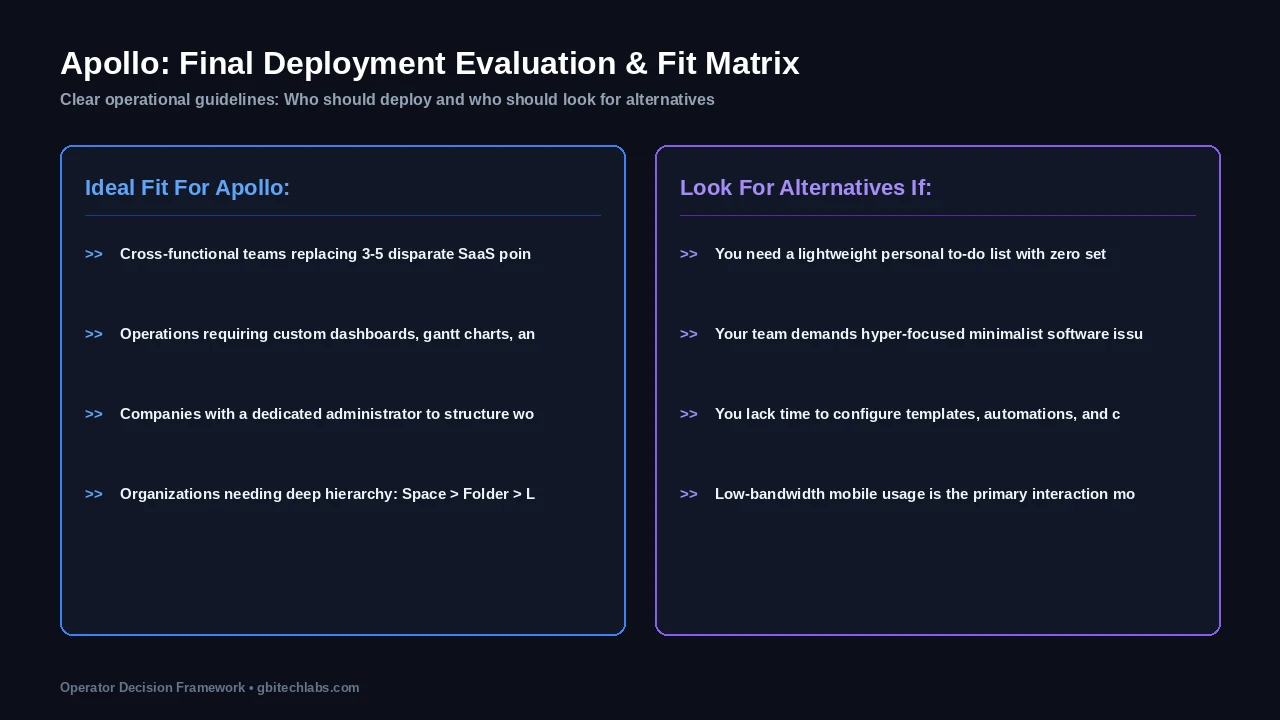
- Depth versus breadth. Organizations with highly specialized requirements — advanced multi-touch attribution, complex territory modeling, or deep CRM-native customization — may find that Apollo’s consolidated approach trades specialist depth for generalist coverage. In those cases, a best-of-breed stack may outperform a unified platform on specific dimensions.
- Data quality variance. Apollo’s database is broad, but breadth and precision are not the same property. Teams operating in niche verticals or geographies should evaluate coverage against their actual addressable market rather than aggregate database size.
- Workflow lock-in. Consolidating prospecting, sequencing, and analytics into one platform increases switching costs over time. That is a benefit for operational coherence and a risk for future flexibility.
Recommendation by Buyer Profile
Buy Apollo if: the organization is running a high-volume outbound motion, lacks dedicated RevOps infrastructure, values toolchain consolidation, and operates in a market segment where Apollo’s data coverage is demonstrably strong. The integrated data-plus-engagement architecture delivers compounding operational efficiency in this profile.
Consider alternatives if: the organization requires specialist-grade capabilities in a single function (e.g., enterprise-grade intent data, complex attribution), operates in a vertical with thin data coverage, or has already invested heavily in a best-of-breed stack where Apollo would duplicate rather than replace existing tooling.
Evaluate with a structured pilot if: the organization sits between these profiles. The decisive variables — data coverage in your specific market, sequence deliverability, and CRM integration fidelity — are empirically testable within a bounded trial period. The key architectural factor is not whether Apollo can do each thing, but whether the integrated whole outperforms the sum of the parts it would replace.
Final Position
Apollo is a defensible buy for teams whose primary constraint is operational fragmentation rather than functional depth. It is a weaker fit for organizations whose competitive advantage depends on specialist tooling in any single layer of the revenue stack. The recommendation is conditional, not universal — and the condition is organizational architecture, not product quality.
Frequently Asked Questions
What are the core capabilities of Apollo?
Apollo is an all-in-one productivity and project management ecosystem engineered to consolidate tasks, docs, goals, and team communication into a single unified workspace.
Does Apollo have a free tier or trial?
Apollo operates on a tiered subscription pricing model, offering an entry tier for smaller teams and escalating tiers that unlock custom automation, expanded storage, and enterprise administrative controls.
How does Apollo compare to its closest competitors?
Viable alternatives to Apollo depend on team focus: lightweight tools offer faster onboarding for simpler projects, whereas enterprise platforms provide deeper permission hierarchies and custom database relationships.